
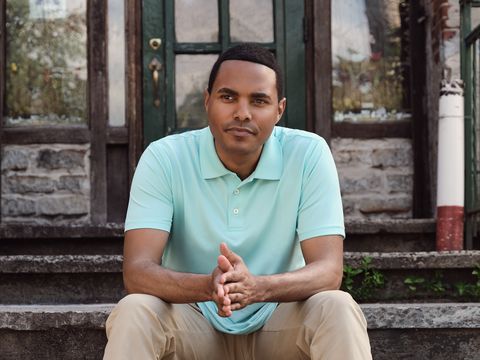
Congressman Ritchie Torres is trying to be normal, bless his heart. He’s standing in line at the U.S. Capitol’s on-site Dunkin’ on a recent Tuesday morning, waiting to order his breakfast of a small macchiato with almond milk. Suddenly, the man standing in front of him, a young aide to a Florida congresswoman, lights up with recognition.
“I’ve been hoping to run into you,” he tells Torres. “You’re such an inspiration. You’re a trendsetter for so many people like me!” Then, as the aide realizes he is creating a small scene, he picks up his voice as he looks around and points dramatically to Torres, who is 34. “This man will be Speaker of the House someday!” the aide announces to the few dozen people in the coffee shop. Torres blushes and finds himself at a rare loss for words.
The New York Times has called Torres a “superstar” and “perhaps the most singular political talent of his generation.” A Politico reporter called him “one of the most consistently sharp questioners” in Congress. And Newsweek reported that “some whisper he’ll be the country’s first gay president.” New York governor Kathy Hochul considered him for her lieutenant governor. Stories about him are built around what some leaders of his party declare is his most special quality: He’s the first openly gay Afro-Latino member of Congress. Anchors on GMA3 once said it three times in 70 seconds.
That kind of fawning attention can make him seem like a political darling, but his 2020 congressional bid succeeded without the support of his local Democratic Party, the Democratic Congressional Campaign Committee, or an endorsement from Rep. Alexandria Ocasio-Cortez, the famous young congresswoman whose district abuts Torres’s and who has a side hustle anointing fellow Democrats as AOC-approved. (She declined to be interviewed for this article.)
Torres raised $1.7 million and won anyway. “I’m emboldened by low expectations. I invite people to underestimate me,” Torres tells me.
While it’s true that Torres is alone on Capitol Hill in the combination of his ethnic identity and sexual orientation, what makes him extraordinary is how empirically ordinary he is. In a legislative body stacked disproportionately with dynasties, Ivy Leaguers, and millionaires, Torres, like 62 percent of the country, doesn’t have a college degree. Like 45 percent of the country, he has had a family member in prison. Like 40 percent of the country, he has been on government assistance for more than three years of his life. Like 27 percent of the country, he is estranged from at least one family member. And like 58 percent of the country, his everyday breakfast is just a cup of coffee. (For what it’s worth, the breakfast of choice for the actual Speaker of the House, California’s Nancy Pelosi, is chocolate ice cream.)
Sure, on top of all of that, Torres is gay and—unlike 77 percent of his colleagues in Congress—he isn’t white. His 34 years are dwarfed by the average age of congressional members: 58 in the House and 64 in the Senate. But he doesn’t bring his gayness or skin color or youth to Congress as much as he brings what being gay and non-white and young have taught him about community, about equality, about fairness, about justice, and about opportunity—or, more succinctly, about America.
Every elected official brings to their position a life of experience no one else could. A childhood of hardship or privilege. The shadow of a parent’s success or the heartache of a child’s death. The college professor who told them they wouldn’t amount to anything or the fourth-grade teacher who told them they were everything. The uncle who succumbed to complications due to AIDS, the sister who beat cancer, the ex who became a junkie, the classmate who became a judge, the friend who runs a hedge fund, or the neighbor who runs a daycare. The series of relationships and moments that add up to the everyday and that slowly accrue to a life—these are what a politician brings to the table, what shapes their ideas, their priorities, their votes, and, ultimately, their power.
Robert Smalls, a representative from South Carolina in the 1800s, was born into slavery but freed himself and then created the country’s first required public school system. Daniel Inouye, a representative from Hawaii, served 53 years in Congress despite being rejected for signing up for the military in World War II because of his race (he was Japanese American); his public service, he said, was encouraged by his mother, a homeless Japanese orphan who was taken in by a Hawaiian family—she told Daniel it was his responsibility to repay her debt to Hawaii.
In the current Congress, Katie Porter of California, Cori Bush of Missouri, and Rashida Tlaib of Michigan are three of the country’s roughly nine million single mothers. Congress’s youngest member, North Carolina’s Madison Cawthorn, who was elected in 2020 at 25, sought divorce after less than a year of marriage last year. Ocasio-Cortez is currently engaged. Georgia’s Marjorie Taylor Greene is currently divorcing. These are lives in the everyday flux of any of our neighbors.
The incoming class of Congress that was newly elected this week and will be sworn into office in January includes Florida’s Maxwell Alejandro Frost, whose birth in 1997 makes him the first Gen Z member of Congress, and California’s Robert Garcia, who became an American citizen after being undocumented and will become Congress’s first openly gay immigrant. Congress is now rapidly diversifying with every election.
And yet even as Torres’s demographics are interesting and original, they are not necessarily prescriptive. There are lots of ways to be Afro-Latino and gay. Black voices on the Supreme Court range from Clarence Thomas to Ketanji Brown Jackson, and women’s voices in Congress range from that of the progressive Ocasio-Cortez to QAnon-flirter Greene. Torres is more than the sum of the various identities on any form he could fill out.
Any legislator can declare a war on poverty, as did Lyndon B. Johnson, who grew up poor. Any legislator can spend hours touring poor neighborhoods in an effort to understand the chaos, as did Ted Kennedy, who grew up rich. Torres? He’s using his limited power—he is only one of 441 members of the House of Representatives, after all, and a freshman at that—to try to pick off the problems he knows best.
Whatever you call his mojo—confidence, swagger, arrogance, self-esteem, reclaimed power—Torres’s identity is rooted in the tangled awareness that his life’s crises and setbacks and tragedies have not been born out of his Blackness, his queerness, his Latino heritage, or his zip code—but rather the systems of bigotry, bias, exclusion, and inequity that were (and still are) seeded into his life’s harvests by America’s intrinsic brokenness in its eternal quest toward a more perfect Union.
“There was no model, no precedent,” Torres says of his ascent into Congress. “I had to create a model of my own.” That untested quality of his life has amplified his introvert tendencies. “I am reflective by temperament,” he says, “but also by necessity.”
So, yes, he’s the first openly gay Afro-Latino person elected to Congress. What now? What next? What’s he going to do with that faith and power and trust?
***
Along the boundary of Fordham University in the Bronx is a modest yellow house. Behind it, on the same property, is an even more modest detached unit. Torres lives on the second floor of that in a one-bedroom apartment. His rent is $1,300 a month. (His congressional salary is $174,000 a year.)
Discarded chicken bones and ravaged cartons of beer litter the driveway, which is lined by a barbed-wire fence. Early one recent morning, Torres beckons me to his porch. I am not allowed inside (nobody is except Angel Vazquez, his chief of staff). He points to a pile of at least a dozen garbage bags outside. “It attracts a raccoon,” he says. “Can you believe I live next to this?”
He’s been thinking about moving because of an increase in violent crime nearby: officers shot in November 2021 and January this year, an 11-month-old girl shot in the face by a stray bullet the very next day that January, a 16-year-old girl killed by another stray bullet from a ghost gun in April. As the neighborhood’s congressional representative, he attends memorials. As a resident, he fears for his safety. His trauma can sometimes feel like it’s in his blood. His maternal great-grandmother was murdered, he told me in the casual dispensing of horror that has long-blighted America’s forgotten margins.
Slightly after Rihanna but slightly before Adele, Torres was born in 1988 alongside his twin brother, Reuben—he also has an older sister, Melissa, by another father—and raised by his single mother in Throggs Neck Houses, a public housing project known for broken heaters, leaky pipes, lead paint, mold, rats, and roaches. He got stuck so often in the building’s elevators that he still carries a fear of them.
In his earliest awareness of class divide, in his younger days before attaining political power, Torres was both confused and enraged that across the street from his derelict home, the city was giving around $100 million to develop a golf course, which was eventually opened by Donald Trump. “That’s when I realized I can’t take for granted that the system will work out for me,” he says.
Growing up, he mostly kept to himself. He was always underweight and was frequently hospitalized because his environment’s unsanitary conditions gave him severe asthma. He was beaten up at school—once by several boys who kicked his head. (One of them ended up murdering someone a few years later, Torres recalls.) “If I had sent my boy to school all battered and bruised like that, I’d have child services at my door,” says his mother, Debbie. “But his school sent him home to me like that and just says, ‘Boys will be boys.’”
Debbie rotated through a scramble of here-and-gone jobs. A Domino’s delivery person one week, a mechanic’s assistant the next—whatever it took to make rent, which was capped at 30 percent of her income with no minimum. A typical month, she says, brought in roughly $400, which would’ve meant $120 in rent. Desperate to help out, Torres once panhandled on the subway, bringing home a bag of $180 mostly in coins from one day’s effort, Debbie recalls. She nonetheless quickly discouraged it, for fear he’d get mugged or have a run-in with cops.
At the time, the Bronx was one of five counties in the nation where more than 30 percent of households were run by single mothers, according to a study by Lehman College. (Three of those counties were on Native American reservations in South Dakota, the other in Mississippi.) In speeches, Torres refers frequently to the single mothers of the Bronx as the community’s core power players. “The essential workers of the Bronx,” he called them at a food-stamp event recently. “The essential mothers of the Bronx.” In the context of the Bronx’s crucible of crises, Torres’s race and sexuality are secondary to what has become perhaps the central focus of his legislative service: his love for his mother. “Voters came to see me as their son and grandson,” he likes to say. A tight-knit family of, at last count, 732,872.
***
Torres has almost no relationship with his father, Bartolo Torres. “I rarely saw him as a child and rarely see him as an adult,” he says. “I feel no ill toward him—he always struck me as a good man.” I ask him if he ever missed father-son moments like learning sports or how to shave. “It’s hard to miss something I never experienced,” he says.
Last year, Torres ran into Bartolo in the street. They exchanged terse pleasantries. It was the first time Torres had seen him in a long time. I ask Torres who his father is to him today. His answer comes quick and cold: “He’s my constituent.”
These are the kinds of things Ritchie Torres does as a congressman: He co-authored a letter to federal health agencies, including the CDC, asking to require insurance coverage of an injectable form of PrEP, the daily pill that helps prevent HIV infection, at no cost to patients. (Torres is not on PrEP.) He advocates to permanently expand the Child Tax Credit because it offers a safety net during children’s shaky early years, a precarity he himself barely survived. He authored and pushed to passage a bill that would extend the Equal Credit Opportunity Act, which requires financial institutions to collect data on credit applications submitted by small businesses owned by minorities or women, to include LGBTQ+ applicants, too.
He frames his priorities as an understanding that, for many of our nation’s problems, “we blame the ignorance of the masses but it’s actually the malevolence of the elite.” He is keenly aware how dependent the status quo is on everyday people being too busy or tired or worn down to stand up for themselves. Even liberal programs, he says, “preach redemption but practice revenge.”
Torres was a third-generation resident of public housing. (His grandparents had lived there since the 1950s.) He began high school in Manhattan but withdrew when he became too homesick and enrolled in nearby Herbert H. Lehman High School. Inspired by the discovery on the MySpace page of Justin Pitts, a young social studies teacher at Lehman, that Pitts was gay—the first out person Torres had encountered, to his knowledge—Torres came out at 16 during a debate about gay marriage. Pitts brought Torres to the latter’s first Pride parade the next year, but it didn’t herald an era of many new experiences. Torres didn’t attend prom, and his romantic life was limited to a single makeout session with a fellow student, an accomplished violinist.
Despite the relative liberation of coming out, Torres began to feel depressed. He played hooky. He spent most of his time alone. “I experienced psychomotor retardation,” he says. “I felt like my IQ had fallen by 20 points.”
He got accepted to NYU—then-billed as America’s top “dream school.” Its cost was tempered by federal grants and a scholarship. But this bright new chapter didn’t help his mental health. The dorms had a room he said was known as the Dungeon, where kids did drugs. “I saw more drugs at NYU than I did in the housing projects of the Bronx,” he says. His roommate was friends with a young Hollywood actor, and the three of them once smoked marijuana—Torres’s first time. Much to the actor’s irritation, Torres recalls, the future congressman blew smoke in his face as he recited the actor’s catchphrase. Torres soon started abusing other drugs, although his candor on the matter does not extend to naming the drugs.
He had become an overnight caretaker for his grandmother during his senior year of high school, and she died his freshman year of college. She’d called him a few days earlier to tell him she loved him. Although he enjoyed some of his classes—especially his philosophy courses—he dropped out of NYU.
He thought back to happy moments and recalled that as a high school student, he had shadowed a local community board leader, James Vacca, and had enjoyed it. He soon began working for Vacca, who had since become a member of the city council. Torres was making just $16,737 a year but making a new life for himself with it.
Yet the depression got worse. He was not formally diagnosed until he was admitted to a hospital after attempting suicide by overdosing on Tylenol.
He was not surviving. He was persisting.
***
After his grandmother’s death, dropping out, his essential re-closeting since that brief bravery at 16, and his attempted suicide, he began to reassemble his life at a three-week rehab center.
He returned to his work for Vacca, conducting housing inspections to document the vile living conditions in his downtrodden borough. His frustration that those in power were so far removed from the reality of Bronx brokenness prompted him to try an unlikely run for city council. He won a seat at 24, becoming the youngest member of the 51-person council.
Now he’s a congressman, running stronger in his sophomore season of politics than ever seemed possible in his sophomore year of college. He won his primary this year without a challenger, won his reelection with 82.6 percent of the vote, and will begin his second term in January—an affirmation of his political power and prowess not granted to every first-time member of Congress. Still, he’s a man who takes an antidepressant for his depression but doesn’t see a therapist. He tries to eat well, but on the day I shadow him in D.C., that morning coffee is followed by nothing but crunched breath mints until a 9 p.m. nibble of spinach dip and a few fries. He sleeps maybe four or five hours a night, and has only recently begun to exercise regularly despite belonging to a gym (he’s now on a late-night weightlifting kick). He has lived to see so many dreams come true. And yes, he’s a United States congressman, but he doesn’t always feel like he’s living his fullest self.
One afternoon, as we walk through his district’s streets, getting greeted by constituents left and right, Torres says something that holds both the weight of his past and the freight he’s trying to carry into the futures of a thousand Ritchie Torreses: “There’s nothing more gratifying than helping people see themselves in you, in the power of personal connection and the honor of kinship.”
He knows how much he and others like him have lost or had stolen. He knows that a life mired in poverty is lonely and exhausting, that it robs opportunity not just to get a good job or to get rich, but to have any kind of life at all, let alone one that you enjoy. He binge-watches Love, Victor and Love, Simon, teen dramas about the struggles and mysteries of sexual orientation, because, he says, “I’m living vicariously the romantic adolescence I was denied.”
He doesn’t want any other children of the Bronx to miss what he missed. “Scars all have stories, but they are often untold or even unacknowledged,” he says.
When New York’s congressional districts were redrawn this year after being ruled guilty of gerrymandering, Torres—up for his first reelection—was the only member of the state’s congressional delegation who made the trek to Bath, New York, the town of more than 11,000 where a judge was making decisions about new congressional districts that would hold for the next decade—five House terms. Torres drove 10 hours—five hours there, five back—to address the court for the three minutes to which he was entitled. He testified that there should be at least one congressional district fully encompassed within the Bronx, in keeping with tradition (that’s his district). He got his wish.
His closest comrade in Congress is his demographic opposite within the House among Democrats: Jake Auchincloss of Massachusetts, a straight, married, white, 34-year-old father of two with an economics and government degree from Harvard, an MBA from MIT, and service in the Marines that included tours of duty in Afghanistan and Panama. Torres is the only member of Congress who has been invited to dinner with Auchincloss and his wife.
“He’s just incredibly smart, and that intellect comes through in very short order when you’re talking to him,” says Auchincloss about Torres, with whom he serves on the Financial Services Committee. “He thinks about things in a sophisticated way—the fundamental driver of events and how things are going to play out. And he’s extremely, extremely good on the policy issues he’s dedicated himself to. He came to Massachusetts for an event in my district on housing. I invited maybe two dozen housing experts—people with decades in housing policy who really know their stuff at the local, state, and federal level—and, in a 90-minute conversation, he absolutely blew them away. They’re still talking about it a year later. His depth of understanding of housing policy combined with his own lived experience is a one-two punch.”
Auchincloss adds: “We need more of the curiosity and humility that Ritchie brings,” and more of his “impatience for bullshit.”
New York’s Mondaire Jones, who was sworn in alongside Torres as the first openly gay Black member of Congress but will not be joining him in Congress’s next term, met Torres in 2018 at a legislative conference in Albany when Jones was still a lawyer at a big firm.
“He has inspired me like he’s inspired so many queer people of color through his own very public journey,” says Jones, who cowrote the PrEP letter with Torres. “It’s the fact that we both grew up poor in addition to growing up closeted and Black. Ritchie helped me think about identity in a better way. We had just won, and I was growing frustrated with the number of interviews that people in the media wanted to give on the subject of making history as the first openly gay Black members of Congress, and what he says to me was, ‘You should be happy that people are covering our race because that will fade and then the coverage will become tougher once we start serving.’”
Torres pays a price—literally—for his intersectional identity in the form of caucus dues, $7,500 here and $8,250 there for an annual total of $30,950 (just one more caucus fee shy of the median annual wage in America of $37,586.03) just to be himself. He was stymied by the Black and Hispanic caucuses’ prohibition on dual membership until he wrote an essay in The Washington Post complaining of the restriction.
Torres is not the first politician to utter impolitic thoughts, not by a long shot—but he seems particularly unafraid, sometimes to the extent that you wonder if we want our politicians to be this candid. In an interview with City & State, a magazine of New York politics, he touted his “raw talent” for oratory and rhetoric in the same breath that he said “I speak better than most white people” in response to people accusing him of having “spoke white.” In May this year, he told a class of graduating high school seniors that they didn’t need to go to college, citing Abraham Lincoln as an example of how far a person can go without a college education. When I ask him if he has a favorite Yankee, given that Yankee Stadium is in his district, he shrugs and says: “I lack the tribal fervor that baseball requires.”
He can seem ignorant, as when I ask if he has interest in an array of plays about gay Black life then running on and off Broadway—two of which had won Pulitzers. Another shrug: “I have a pretty good sense of what it’s like. I don’t need to see a play about it.” And when Vazquez, his chief of staff, who is soon getting married at a city hall ceremony, says that his fiancée is stressing about her hair and makeup for the big day, Torres seems genuinely perplexed. “Why does she care about hair and makeup if you’re just getting married at city hall?” he asks.
Over Labor Day weekend, he took his first vacation in almost a decade—piloting a speedboat with friends on Saranac Lake, near Lake Placid. Until then, he had never taken a proper vacation from his political life, never left New York for any reason other than work, including his visits to his ancestral Puerto Rico. His last vacation was in 2014, when he spent a weekend on Fire Island, a gay beach paradise, reading The Economist. (His leisure reading these days is Twilight of Democracy: The Seductive Lure of Authoritarianism, by the journalist and historian Anne Applebaum.) He likes Basil Rathbone’s 1940s Sherlock Holmes films. He keeps a jar of earplugs at his office desk in Congress to help tune out the world when he reads. He defers questions of style to Vazquez, whose nickname in the office is Straight Eye for the Queer Guy.
Torres frequently sends his staff emails at 3 a.m. His go-to pizza is plain cheese because “most toppings are unimpressive.” He is often deadpan or humorless but jests occasionally with the gloating-yet-charming, bah-dum-bum delivery of see-what-I-did-there dad jokes. He used to be so nervous before speeches that he would gulp a glass of wine first.

He tries to call Debbie once a day to check in. Asked how he spent his birthday in March, he replied by citing an annual tradition of taking her to dinner at Peter Luger, a legendary steakhouse in Brooklyn. His mother’s Twitter handle—despite having two other children—is @RitchiesMother. He wants so much for her, and for the other essential mothers of the Bronx. What does she want for her boy?
“I always wanted Ritchie to have a son just like him, a clone,” she says. “I could help raise my grandson in the White House. And dogs, because you’ve got to have dogs in the White House. But, yeah, I will leave the housing projects for one place only: the White House.”
At 34, Torres does not meet the minimum age requirement for the presidency. So Debbie will have to wait at least until March 2023.
“I can wait,” she tells me. “He’s always been worth the wait. Do you know Ritchie was delayed in talking? I was concerned. I took him to the pediatrician. But, lemme tell you, once he started talking—oooh!—he didn’t stop! He was so quiet when he was very little, but he sure made up for it now.”
***
Over a recent night of dinner and drinks across Times Square with his inner circle of friends—Vazquez, a Broadway producer, a lobbyist, a real estate developer, and a self-identified philanthropist—I ask about how much Torres’s life has transformed over the past decade. The lobbyist twirls her straw in her cocktail and sighs. “I’m waiting for him to be transformed by love,” she says. Torres has had plenty of dates in his life, but never a boyfriend.
His friends pass around the Instagram profile of a man another friend had recommended as Torres’s new paramour: a mostly headless, even more mostly shirtless profile of a Ukrainian immigrant. Sipping his mango mojito, Torres looks at the man’s eight-pack abs, mentioning them frequently as the images are passed around and then gazing at them himself while mumbling “impressive.”
Torres is a curious character: lonely even in a crowd. “As an elected official,” he says, “I am rarely alone but often lonely.” But he’s far more singular than merely single.
I’ve known Torres since 2014, when I wrote about his efforts as a new city council member to build a community center for elderly gay people in the Bronx. In 2018, I texted Torres asking him for recommendations of romantic restaurants in the Bronx. “I don’t know off-hand, but I could ask around,” he wrote back. I quipped that it might help him get more romance in his life to know these spots. “I am a lost cause,” he replied. I joked that the line should be his campaign slogan if he ever runs for mayor, but I also sent a video of a Rose of Jericho re-blossoming and reminded him “Nobody is a lost cause in New York City.”
As his political good fortune has skyrocketed, I’ve often thought about his reply: “My mayoral prospects are greater than my romantic prospects.” When I recently reminded him of this exchange, he was nonchalant about it (he is never, ever chalant). “I’m lonely,” he repeated.
But it’s not so bad.
He strives for his lived experience of excellence and ascent to bloom for everyone regardless of identity. He wants, plainly and firmly, to share the wealth of his good fortune so extensively and intrinsically that America is brimming with public housing residents winning elections, with college dropouts penning op-eds in The Washington Post, and with survivors of suicide celebrating many more steak dinners with their mothers. He doesn’t want to be the only one of his kind anymore.
He aches for his achievements not to make him a breakout star but instead just another casually glittering corner of a new firmament for new heavens. Congressman Ritchie Torres is trying to be normal, bless his heart.
Richard Morgan is a freelance journalist in New York and the author of Born in Bedlam, a memoir.
This content is imported from OpenWeb. You may be able to find the same content in another format, or you may be able to find more information, at their web site.