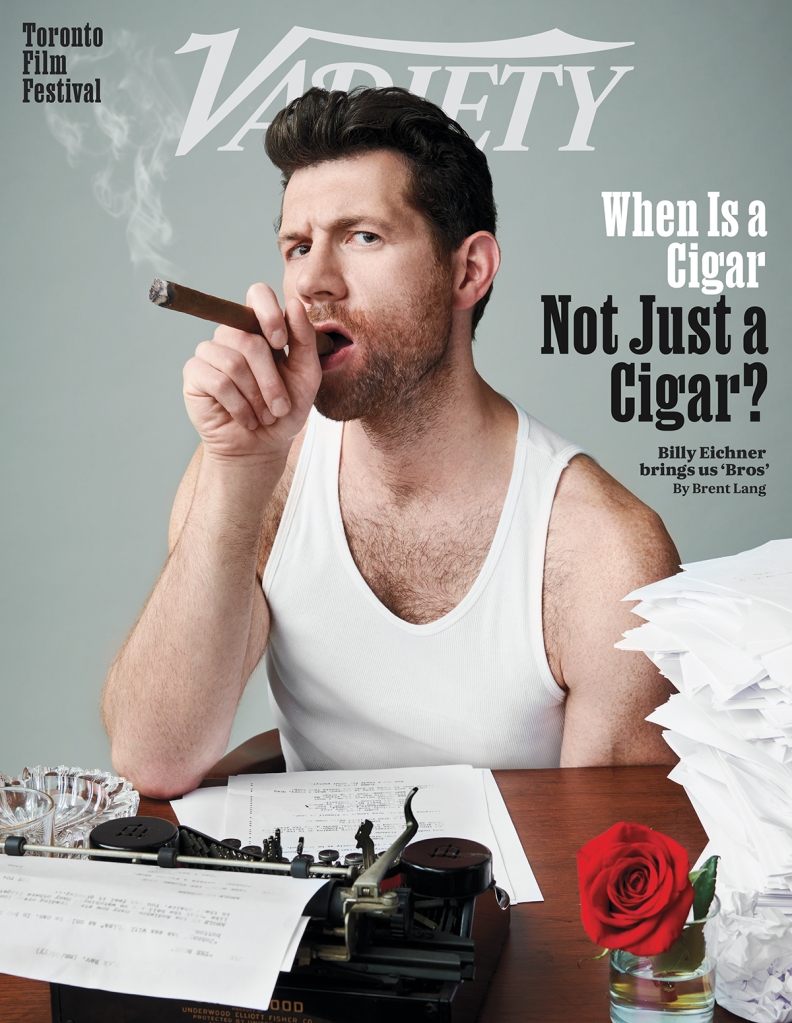
Oops, it happened again. Billy Eichner, eligible gay bachelor, was kicked off Tinder. Somehow, the team behind the dating app had the audacity to boot Eichner from its screens because they thought he was a random loser pretending to be Billy Eichner. Eichner, 43, went public with his Tinder travails during a 2019 appearance on “Jimmy Kimmy Live,” and got an apology from the company along with a care package shipped to his home with T-shirts and mugs that said, “World’s Hottest Single” and “Happy Valentine’s Day … to Me.”
And then, inexplicably, Eichner got dumped from the service a second time last year. “I was like, ‘Fuck it. I’m not going through this again,’” Eichner says, letting out a dramatic sigh. “I can’t book a late-night talk show appearance just to get reinstated on Tinder. I’ll stick to Hinge and Grindr and everything else. I do not need another mug telling me it’s OK to be alone.”
Too many gay men know what that feels like. While single straight women have no shortage of people to relate to in movies, from Bridget Jones to an army of fabulous heroines played by Julia Roberts, Meg Ryan, Reese Witherspoon and more, there has been little representation of gay men looking for love — “Real love, ridiculous, inconvenient, consuming, can’t-live-without-each-other love,” to quote a famous Carrie Bradshaw line — on the big screen. Yes, gay men have flocked to their share of corny meet-cutes starring Sandra Bullock, pining for the perfect guy before ending up happily ever after (even the one where she waited for him to rise from a coma). But growing up during the genre’s ’90s heyday, well, the idea that a studio would greenlight a movie about two men falling in love was unfathomable. At that time, it was refreshing enough just to see a gay friend — say, Rupert Everett in “My Best Friend’s Wedding” — as the fun-loving sidekick, relegated to the sidelines of celibacy.

Jeff Lipsky for Variety
But much has changed in the past 20 years or so. Case in point: There’s now “Bros,” the new Universal Studios romantic comedy, which opens in theaters on Sept. 30 after it premieres at the Toronto International Film Festival and is a revolutionary look at modern love. Finally, there’s a gay romantic comedy that fully embraces its gay characters — in fact, the entire movie is cast with LGBTQ actors, even in the straight roles (except for a hilarious cameo from Debra Messing, playing herself). That’s not the only milestone. Eichner co-wrote the film in addition to starring in it, becoming the first openly gay man to accomplish those two feats on a major studio film of any genre. So, yes, there’s a lot riding on “Bros.”
“I feel a responsibility for it to do well,” says Eichner as he sips iced coffee in the restaurant of a West Hollywood hotel. “I’ve worked so hard on it, I care so much about it, and I want it to do well for the sake of the LGBTQ stories getting greenlit. So there’s a burden I feel, much as I want to sit here and just talk about how funny the movie is.”
The fact that “Bros” is hilarious won’t be a surprise to fans of Eichner. Eichner first came onto the scene knifing across the sidewalks of New York City peppering unsuspecting pedestrians with ultra-specific pop culture questions as the host of “Billy on the Street.” That show started as a viral web sensation before migrating to television, where it developed a passionate following, thanks to its absurdist sense of humor. It’s found a new audience on TikTok, where Eichner’s sound bites regularly get shared.
In person, Eichner is dramatically different from his brash and decibel-busting “Billy on the Street” alter ego. He’s brainy, surprisingly serious, and even a bit reserved (the few times he lets out a boisterous laugh — the kind of roar that turns heads in a restaurant — are the only moments when he evokes his attention-seeking “Billy on the Street” persona). He’s also an open book. After all, how many celebrities would cop to using dating apps, something Eichner does unabashedly. But at the same time, there’s a certain guardedness, as if maybe the slights Eichner suffered on his long road to fame calcified into a protective shell.
Bobby, the work-obsessed podcaster and museum head Eichner portrays in “Bros,” seems much more akin to Eichner’s offscreen self. In the film, Bobby finds himself unexpectedly drawn to Aaron (Luke Macfarlane), a hyper-masculine lawyer who is his polar opposite. Eichner’s character, a smart and brittle 40-year-old whose professional life is thriving as his personal life is withering, also resembles Holly Hunter’s hard-driving producer in “Broadcast News.”
“There’s no character in modern films I relate to more than Holly Hunter’s, because she’s so damn smart, she has all her shit together, and no one is better at her job,” says Eichner. “And yet, she falls for the handsome idiot. And that’s human, especially if you’re a person who doesn’t connect romantically to a lot of people. When it does happen, it can really mess you up.”
“Bros” is rooted in the rom-coms that Eichner grew up watching, but where those stories usually led to little more than a passionate kiss, the characters in this movie get it on … a lot. And the sex they have feels refreshingly real, with just a dash of movie magic — think Nora Ephron on poppers. There’s a cornucopia of post-PrEP, pre-monkeypox sexual possibilities on display, ranging from anonymous hookups to throuples to a first date that ends in a foursome.

Jeff Lipsky for Variety
“To this day, I’m waiting for someone at the studio to call me and go, ‘You know, now that we think about it, you’ve gone too far.’ But it never happened,” says Eichner. “There’s part of me that realized some of this would be eye-opening for certain people in the audience, and I loved that too. I was like, ‘Great! Let’s surprise people. Let’s shock them.’ Sacha Baron Cohen doesn’t worry about that — why should I?”
“Bros” is part of a wave of new shows and movies — such as Netflix’s “Uncoupled,” with Neil Patrick Harris as a newly single middle-aged gay man, and Searchlight’s “Fire Island,” with Joel Kim Booster and Bowen Yang as gay friends on vacation — that come from LGBTQ creators and depict queer life with a newfound sexual candor.
“Things have been changing so much; everything is shifting,” says Harvey Fierstein, who broke barriers when his gay coming-of-age story “Torch Song Trilogy” debuted on Broadway in 1982. “Being gay these days — just being plain gay — is so mainstream compared to everything else there is to choose from. Just being gay or lesbian is so boring. We’re having kids; we’re getting married. I feel like I should just go to the Stop & Shop and shut up.”
But “Fire Island” and “Uncoupled” debuted on streaming services. To succeed, “Bros” needs to convince consumers to buy a ticket. And while a handful of romantic comedies like “Crazy Rich Asians” and “The Big Sick” have managed to defy the odds and thrive at the box office, they remain the exception to the rule. The financial realities of Hollywood are such that studios are focused on creating global blockbusters that spawn toy lines.
“It’s a weird time for movies because of the pandemic and streaming and the massive investment in comic book movies,” says Judd Apatow, co-producer on “Bros.” “We’re not seeing all sorts of movies, but it doesn’t mean the audience doesn’t want them desperately. We don’t have them because even when they are successful, they don’t make a billion dollars. And a lot of the studio system is built on trying to make astonishing amounts of money.”
Eichner has been staying up worrying that the film won’t appeal to a broad enough audience, and the fact that he does annoys him. “Universal has a rom-com with George Clooney and Julia Roberts [‘Ticket to Paradise’] coming out a month after ‘Bros,’” says Eichner. “I love Julia Roberts more than life itself, but no one is going to ask Julia Roberts and George Clooney, ‘Are you worried that gay people are going to relate?’ No straight movie star or straight director in major studio history has ever sat there and worried, ‘God, I hope gay people show up in droves.’”
And Eichner knows who to blame. “Hollywood took a century to make this film,” he says of “Bros.” “That’s not my fault — that’s Hollywood’s fault for taking this fucking long.”
“Bros” is hitting theaters at a time when more LGBTQ stories and artists are getting a chance to shine. But all that progress is still threatened. The film is premiering as antitrans laws are being pushed in several states. Even those rights that have been secured, such as same-sex marriage, may be overturned by a conservative Supreme Court. “We’re always going to have to keep fighting,” says Eichner. “We’re even going to have to keep fighting for the handful of rights that we managed to acquire, because every time we make progress, the other side gets scared and pushes back.”
Eichner is from Forest Hills, Queens, a continent and several subway stops removed from Hollywood, a place where show business feels like a distant dream. His father, Jay, was a rent-tax auditor, and his mother, Debbie, worked for a phone company. But both parents loved music and theater, and they took him to see Nathan Lane in “Guys and Dolls” on Broadway, Bette Midler at Radio City Music Hall and Barbra Streisand at Madison Square Garden. When his aunt questioned his parents about their decision to bring Eichner to a Madonna concert, his father shut her down with “She’s a great performer.” That love of entertainers was something that bonded the family.

Jeff Lipsky for Variety
Jay and Debbie Eichner also believed that their son could be a star, ferrying him to auditions when he was an aspiring child actor (aside from being an extra in a “Saturday Night Live” skit, he had limited success) and later going to see nearly every one of his shows when he was a theater major at Northwestern University. “I was the center of their universe,” Eichner says.
It was the age of “don’t ask, don’t tell,” and the shadow of AIDS still lingered, but Eichner never struggled with being gay. “It looked chic,” he says. “I watched a lot of shows about fashion, and Madonna was always palling around with her gay dancers. On ‘The Real World,’ there was always a cool and artsy gay man who went to fun nightclubs, and I wanted to do all of that.”
Of course, he knew that homophobia was out there, but it wasn’t a big deal for Eichner growing up. “Did some bully in the schoolyard occasionally say the f-word or say, ‘You sound gay’?” says Eichner. “Yeah, that happened a handful of times over the years, but I never brought it home with me. A lot of people assumed I was gay, but I was very tall, very imposing — I wasn’t frail. So, for whatever reason, I never got picked on.”
But trying to break into the entertainment business exposed Eichner to the bigotry he had mostly avoided. There was the theater agent who advised him to tone down the gay content in “Creation Nation” — the stage show that gave him his first brush with professional success — because agents from William Morris might be in the audience. In response, Eichner included more anal-sex jokes. And then there was the top Comedy Central executive who listened to Eichner pitch a show and told him that it sounded like a better fit for Bravo, home of “Queer Eye for the Straight Guy.” “Bravo was the one major cable network that would have gay men on their shows, but they weren’t doing comedy shows,” Eichner says. “They were doing reality shows. I was like, ‘I’m not a stylist; I don’t do people’s hair.’ There’s nothing wrong with doing those things, but I’m a comedian.”
Even when Eichner’s style of comedy was embraced, he had to fight to keep the industry from sanding off its edges. After cable channel Fuse agreed to air “Billy on the Street,” one executive suggested that he lose the show’s peppy jingle. “He thought it sounded too gay,” says Eichner. “I remember him telling me, ‘We need to open with a hip-hop song so the show feels relevant.’ I was like, ‘That makes absolutely no sense.’ That was an out-of-touch person who was desperate to feel important. There was a reason he worked at a very obscure cable network.”
Before his career in comedy took off, Eichner tried to make it as an actor in New York. But casting agents didn’t really know what to do with him. So he decided to make his own opportunities, partnering with best friend Robin Lord Taylor on “Creation Nation,” a variety show that mixed stand-up, satirical songs and sketches. In 2004, to bolster the act, Eichner started taping segments in which he would approach hapless New Yorkers and engage them with silly contests about pop culture (sample questions: “Who’s weirder: Tom Cruise or John Travolta?” and “True or false: Lea Michele can play the flute”). On “Billy on the Street,” Eichner was abrasively manic in a five-boroughs way, sliding up to people with complete self-assurance and then dismissing them abruptly when he found their answers lacking.
“The way he zips into the frame, it’s like he’s a cartoon character,” says Conan O’Brien. “It’s like Daffy Duck, who would just hurtle onto the screen and then stop and vibrate for a second and then — zing! — he’s gone again.”
The show’s breathless treatment of frivolous subjects seemed to anticipate the new brand of celebrity culture being ushered in by social media and glossy magazines that rhapsodized about the love lives and professional triumphs of stars. The taped bits quickly became the most popular part of “Creation Nation,” and Eichner attracted a following among influential comedians.
“Billy always felt a step ahead of the zeitgeist as opposed to a step behind it,” says Seth Meyers. “His comedy is not reactive; it’s proactive.”
Eichner was unique in another way too. He was out and proud long before it was fashionable. “That was not done back then,” says Taylor. “I was an actor, and I was discouraged about coming out of the closet. People were saying, ‘It’s going to limit what roles you’re going to play.’ But the comedy world, that was just straight-boy central. There was no room for gay people. And it was very shocking to some audience members that Billy was so frank about being gay.”
But Eichner didn’t wait for the entertainment business to make space for him. As he started “Billy on the Street,” YouTube was democratizing the way talent could get noticed. And Eichner took full advantage of the change. Early “Billy on the Street” videos were lo-fi affairs, but the show was filled with dazzlingly absurd deep dives into pop culture ephemera, delivered with a blistering intensity that demonstrated Eichner’s comic brilliance. He didn’t need some studio executive to give him a break.
“Billy forged his career completely himself,” says O’Brien. “It’s not like someone saw him and said, ‘You, kid, you’re coming with me. We’re going to fix your teeth and teach you to stand up straight and make you a star.’ He is completely self-directed, and he relied on gobs of talent and tremendous drive.”
There were some celebratory articles about “Creation Nation,” but it took time for the buzz around the show to translate into the kind of career that would enable Eichner to pay his bills. “I was starting to get concerned,” admits Eichner. “As dedicated as I was to this dream of being successful as a performer, I was starting to worry. It’s cute to struggle in your 20s. In your early 30s you start to get anxious.”
When Mike Farah, an executive at Funny or Die, sent him an email praising his videos and telling him he’d love to meet with him if he was ever in Los Angeles, Eichner pounced. “I lied and told him that, as a matter of fact, I was coming out to L.A. in a couple of weeks — isn’t that weird?” remembers Eichner. “I had no money at the time. I was broke with no health insurance. But I put a plane ticket on a credit card, crashed with friends and went to see Mike. I said, ‘I’ll make videos for Funny or Die if that’s what you want, but I have this bigger idea to turn my segments into a TV show.’”
Farah bit. With Funny or Die’s backing, “Billy on the Street” nabbed distribution on Fuse and later TruTV. That led to supporting roles in shows like “Parks and Recreation” and films like “The Lion King.”
But Eichner’s parents, his biggest boosters, weren’t around to see it. Debbie Eichner died of a heart attack at 54, when her son was 20; his father, Jay, died in 2011 at the age of 80, a month before “Billy on the Street” was pitched and sold to Fuse.
“Life is unfair sometimes,” says Eichner. “My parents believed that I could star in movies and that I could fulfill this dream of success in entertainment decades before Hollywood did. They weren’t around to see it happen, but they are the reason it happened.”
To make “Bros,” Eichner partnered with two straight men with serious commercial clout. The film was co-written, produced, and directed by Nicholas Stoller (“I’ve been trying to convert him,” Eichner jokes), the man behind “Forgetting Sarah Marshall” and “Neighbors,” and produced by Apatow, whose comedy empire extends from “Superbad” to “Bridesmaids.” Stoller was a longtime associate of Apatow’s and approached Eichner with the idea of developing a movie together after they had worked on “Neighbors 2: Sorority Rising” and “Friends From College.”
“I’ve never written a movie, and I needed Nick’s experience. And I needed him and Judd to help sell the movie,” says Eichner. “I educated Nick on the gay experience, and Nick walked me through the process of developing writing and then making a major studio film.”
Both Apatow and Stoller have minted money with their comic explorations of men in a state of arrested development, and Universal felt that switching the sexuality of the protagonists in one of their comedies could make the film pop.
“This kind of gay-relationship comedy had always been given niche treatment,” says Donna Langley, chairman of Universal Filmed Entertainment Group. “Wrapping it up in a major studio package felt like a big idea to us.”
It was Stoller who first had the idea to make a romantic comedy about a gay couple. And he thought that Eichner was perfect to star in a movie about falling in love in the age of apps. It turned out that Eichner also had an embryonic idea about a cerebral man smitten with a jock and was looking to tell a story about older gay men. “Most of the LGBTQ content today is about gay teenagers who are presented in a very sitcom-ish fashion,” says Eichner. “We’re wearing cutesy little outfits, and we’re there to be charming. I don’t relate. Where are the adults? I look at this queer programming, and I don’t know who these gay men are. They don’t look, sound or behave like me and my gay friends.”
Stoller and Apatow urged Eichner to put more of himself into the film. “These movies are ways for people to figure something out about themselves,” says Apatow. “I usually ask people, ‘What would need to happen for you to get healthy and figure out all the things that were blocking you in certain areas of your life?’”
About halfway through “Bros,” there’s a scene on a beach in Provincetown where Bobby lets his guard down with Aaron, talking about all the people who told him that being gay would derail his ambitions — the same prejudices Eichner had to overcome in the entertainment industry. It’s the movie’s most personal moment. While editing the film, Stoller presented a shorter version of the scene, but Eichner pushed back. He wanted to “live in the moment more,” so that audiences would get a better sense of who Bobby and Aaron were as people. That would make them care more about whether they ended up together.
“Billy was right,” says Stoller. “It’s a moment where you can hear a pin drop in the theater. And in focus groups, when people are asked, ‘What’s your favorite scene?’ they always mention Bobby’s monologue. And it’s not Maya Rudolph pooping in the street [in ‘Bridesmaids’], which is usually the kind of thing people pick. But everyone has felt like an outsider.”
Eichner was determined to use “Bros” to shine a light on a new generation of LGBTQ talent. He filled out the ensemble with trans, lesbian, bisexual and nonbinary performers, many of them people of color. Says Miss Lawrence, a gender-nonconforming actor who plays a museum board member in the film, “Coming from the Deep South as an old Black queen, I never really thought that my gifts and talents would be celebrated by the masses. But walking onto the set of ‘Bros,’ I was surrounded by the full range of the LGBTQ community — from our designers to our PAs to our cast. And then to have this film backed by Universal, it’s a dream come true.”
Eichner was sick of straight actors getting all the great parts, even the gay ones, so he made sure that this time, all the roles, even the straight ones, were played by queer actors. “I’m not arguing with the fact that Sean Penn was magnificent in ‘Milk,’ or that Heath Ledger was heartbreaking in ‘Brokeback Mountain,’” says Eichner. “It’s not about saying a straight actor should never play gay. But we need a more equal playing field. It’s about correcting a very extreme imbalance.
Eichner wants to tell more LGBTQ stories. He’s collaborating with Paul Rudnick on a “War of the Roses”-style comedy about two gay men getting divorced that has the working title “Ex-Husbands.” He’s also planning to make a film about Paul Lynde, the campy character actor who became famous on “The Hollywood Squares” in the 1970s.
But don’t hold your breath for another season of “Billy on the Street.” “I might revive it for a special occasion, but the TV series is done,” says Eichner. “I will never do it again in any regular fashion. I have no desire to be a 44-year-old man running around the streets all year long screaming at people.”
When Eichner does a project, he goes all-in. He says he couldn’t balance another season of “Billy on the Street” with the other projects he wants to make, because he sweats every quip, each pause, even the smallest music cue. He is passionate about the work he does. But making “Bros” also made him reconsider his approach. “Honestly, the movie reminded me not to ignore what’s really important in life, like love and romance,” says Eichner. “Show business is not the most important thing in the world regardless of what Mary Hart and John Tesh told me when I was a child.”
One day last fall, “Bros” was on the Upper West Side filming a scene where Bobby and Aaron walk around the same streets where the likes of Harry and Sally once strolled. Eichner’s mind was going a mile a minute — he wanted to make sure the production capitalized on the fading light and that the dialogue was punchy enough. It needed to be perfect. And then he stopped and realized something bigger was going on.
“I told myself to look around and appreciate how rare and magical this moment is because you are making a movie that looks and feels like all the romantic comedies you grew up loving, but you’re doing it as a gay man,” says Eichner. “And this is not an indie movie. This is not some streaming thing which feels disposable, or which is like one of a million Netflix shows. I needed to appreciate that ‘This is a historic moment, and somehow, you’re at the center of it. You helped create it.’”
The feeling didn’t last. “I went right back to panicking about whether the jokes were funny enough,” Eichner says. “And if I was any good in the movie.”
Spoiler alert: Holly Hunter would be proud.