
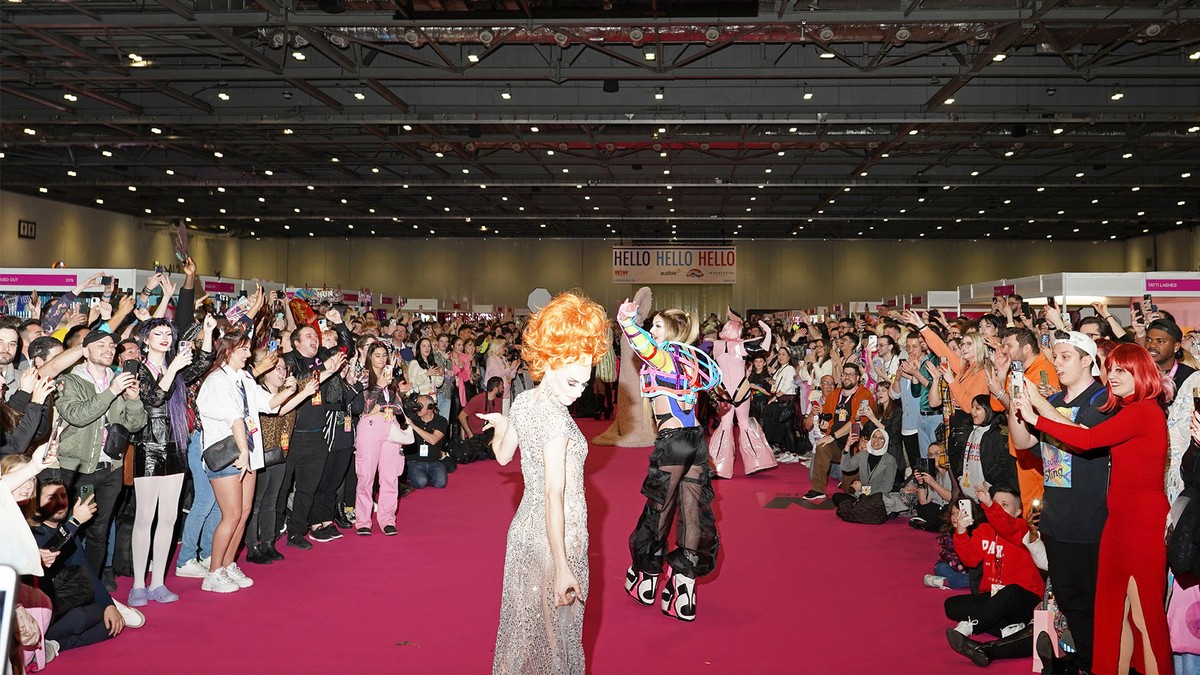
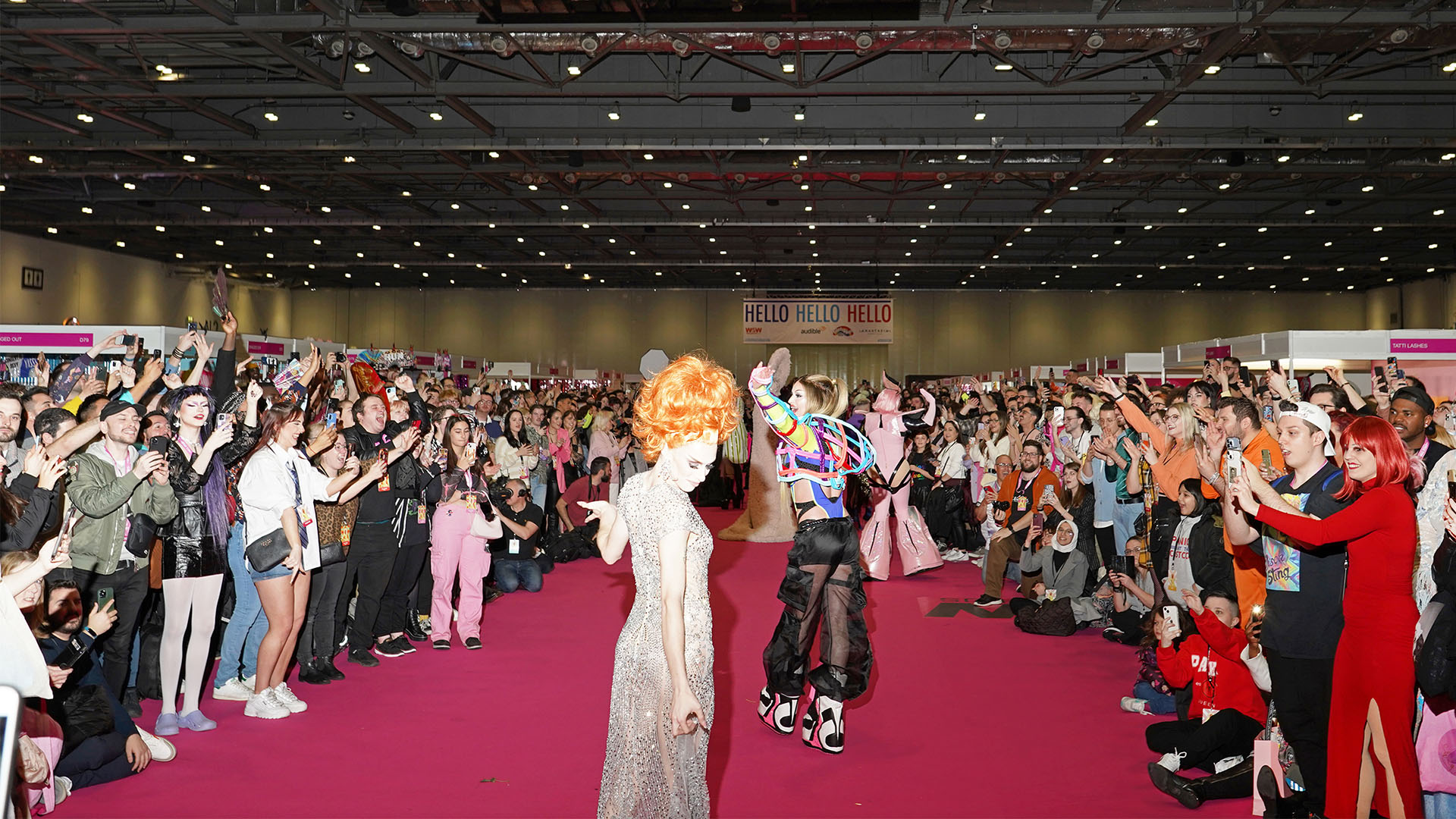
Where were you on January 6th? This year, I know precisely where I was: standing halfway between “Deathdrop Alley” and “Henny Lane” in a spot that, for the next three days, would be officially known as “Glamazon Boulevard”. It was a grey Friday morning in London, but inside the ExCeL Centre, RuPaul’s DragCon UK had transformed the space into a bright, glittery and very pink monument to the world of RuPaul’s Drag Race – the global reality TV franchise that catapulted drag into the mainstream.
I stood on the fuschia carpet waiting for The Queen’s Walk, the opening runway show that would kick off proceedings. As fans began to pour in, I was soon squashed up against a nearby retail stall, which sold large paper fans emblazoned with words like “SLAY” and “WERK”. Right on time – a rare occurrence when it comes to drag queens – music started pumping overhead and the queens began sashaying down the pink carpet. Drag Race UK series two winner Lawrence Chaney kicked off proceedings, followed by Drag Race royalty from other seasons of the show in the UK, US, Canada, Thailand, Holland, Italy, Spain, Philippines, Australia and France.
I watched a young woman physically sobbing as the queens walked the carpet, while fans shrieked and a sea of smartphones captured every moment. For these attendees, it felt like they were living out a dream: to be witnessing the magic that happens on the main stage of RuPaul’s Drag Race.
A huge convention like this would have seemed unthinkable in decades gone by, when most forms of queer self-expression were confined to the margins. But now drag is mainstream and, for some people, a very profitable endeavour. So how do drag fans and performers feel about the Drag Race-ified, more commercialised landscape we see today? And where will the art form go next?
In the US, RuPaul’s DragCon LA has been running since 2015, while DragCon NYC – billed as “the world’s largest celebration of drag culture” – launched in 2017. The first RuPaul’s DragCon UK took place in 2020, just before the COVID-19 pandemic. There were some teething issues; some fans demanded “Ru-funds” for the long queues, with a few comparing the event to Fyre Festival. But three years on, it seemed like a slicker operation with much more “talent” – to use the industry parlance – in attendance. The BBC, after all, has now aired four series of Drag Race UK, plus The UK vs The World, which saw international queens competing against British “all stars” for the first time.
After the opening runway, I watched RuPaul Charles, the supreme leader himself, deliver a DJ set as the smell of chicken from a nearby food truck wafted across the crowd. An out-of-drag Ru stood above a giant screen, where giant images of himself in drag were displayed, while a squad of male dancers in tight clothing danced at the front of the stage and fans screamed. Right at the other end of the hall, by the entrance, there was a long queue for a photo-op with Ru’s right-hand woman Michelle Visage.
RuPaul and Visage bookended a hall packed with different booths. Most belonged to former Drag Race contestants, who each have an “open-ended” invitation for a free space by organiser World of Wonder. Every booth had a strikingly different aesthetic, reflecting each queen’s personality and brand. Baga Chipz styled her booth as a laundrette, Veronica Green’s had a fairytale-like woodland vibe, Lemon’s was, unsurprisingly, a beacon of bright yellow. Thai drag superstar Pangina Heals scrawled “SHE WAS ROBBED” across the back of her area – a reference to her controversial elimination from UK vs The World. Outside the booths, fans queued to buy merchandise and pay for a signed photograph with their favourite queen.
Elsewhere, there were businesses selling drag-related products, from footwear to makeup and wigs. Charities like Switchboard LGBT+ and WWF had stalls. There was a memorial space for Cherry Valentine – a performer who passed away in 2022 after competing on series two of Drag Race UK – where fans could sign a memorial book and donate to a charity in her name. There was a “Kids Zone” too – DragCon is marketed as a family-friendly event – where children could play with toys and listen to stories read by drag queens. Audible, the audiobook service and subsidiary of Amazon, had a large space that hosted panel discussions about Black excellence, drag’s Asian diaspora and the importance of reading and writing.
Who goes to an event like this? Walking around DragCon, I was struck by just how many different types of people were drawn here. Yes, there were some archetypes I expected to see: teenagers with blue and purple hair wearing signed drag merch, twinky gay boys with curtains and a smokey eye, plus a lot of attendees in full drag. (The standard was so high that it was often difficult to decipher between Drag Race queens and DragCon guests).
I approached an attendee who I knew wasn’t a Drag Race star, but looked as though they could be. She was a 19-year-old drag performer called Rosy Cheeks from Edinburgh, Scotland. Rosy works in an Edinburgh gay bar, but has been pursuing her dream of becoming a drag performer for a year, after being inspired by Scottish queens like Ellie Diamond and Lawrence Chaney’s success on Drag Race UK.
She has performed all over Scotland, but has dreams of going further afield. “I’d love to [have a booth], I think every queen would love to,” Rosy says. “Once you’re on the show, you know you’ve made it and everyone knows who you are. I’d love to be international, I’d love to be everywhere.”
Elsewhere, there was no shortage of Drag Race superfans. James Robinson, 45, was perhaps the biggest of all. He had travelled all the way from Alabama to attend DragCon UK and is widely known in the fandom as “Tattooed Superfan,” because most of his body is covered in Drag Race tattoos. He estimates he has spent $40,000 on his tattoo collection, which includes the names of every queen who has ever appeared on the show. He plans his entire year around attending Drag Race conventions, tours and events. “My husband supports me in everything I do,” he says. “Is it a big expense? Yeah, but it’s a part of my life.”
For Robinson, DragCon is about seeing his favourite queens, but also being seen himself. “I love when the queens see me and react to my tattoos,” he says. “When I arrive here, the queens all know me.” At a time where even devoted fans of the show are expressing fatigue at the sheer number of seasons, he disagrees. “There can never be too much drag or Drag Race,” he says. “I hope it goes on forever.” Does he regret having the names of contestants like Sherry Pie and Scarlet Adams – who were embroiled in catfishing and racism scandals respectively – on his body? “No.” And where does he draw the line? “I’ll never draw the line!”
Not everyone I spoke to was as invested as Robinson. But on the whole, attendees were bound together by being superfans of Drag Race – much more so than by their age and appearance. One demographic I expected to see represented at DragCon in huge swathes was huns: women with immaculately blow-dried hair, leopard print clothing and freshly manicured nails, perhaps enjoying a girly day out. This expectation seemed to be misplaced, though. There is considerable crossover between British drag and hun culture, which is visible in the rise of hen dos at bottomless drag brunches and drag bingo. But DragCon wasn’t a space for casual drag fans – it was a haven for hyper-engaged superfans who love specific drag queens and the minutia of the Drag Race fandom, and were willing to pay to experience it in person.
For every person I expected to see, there were others I didn’t. Mother-daughter duo Diana, 64, and Holly, 35, had travelled to London for the weekend from Rotherham and York. They were given their weekend passes by Diana’s husband as a birthday gift after watching the show and going to see queens like Bianca Del Rio perform live. “When I was young I was a punk rocker, which was a rebellion against the norm,” Diana says. “I put all that away and became a parent, but now I’m at the other end of my life, I’m enjoying that self-expression again.”
On day one, I spotted husband and wife Martin and Sherry, both 48 and from Kent, clutching each other’s hands. They explained that Martin has dabbled in cross-dressing since childhood and watching Drag Race together has helped Sherry understand him. Drag and cross-dressing aren’t the same thing, but they say it’s still brought them closer as a couple. “I wish it’d been a different time for me when I was younger,” Martin says. “I would have loved to have done drag, but I can’t sing and I can’t dance. I’m a typical bloke’s bloke, to be honest with you.” Sherry thinks drag seems much more empowering now: “Men dressed as women were either a joke on TV, or simply wrong,” she says. “But now it’s about freedom.”
Every DragCon attendee I spoke to seemed to be having a great time. But wandering around the hall, watching long queues of people waiting to pay for a minute-or-so of face time with their favourite drag queen, I couldn’t escape the slight bleakness to it. Perhaps this is because, as a fan of drag – but not, crucially, a superfan – I’m not the target market here. There was no shortage of joy and an overwhelming feeling of safety in the convention hall, but it was still difficult not to feel bad when passing the booths which were deserted. For every queen with hundreds of fans and a flashy booth – perhaps a famous contestant from America, or a series winner from the UK – there were other queens sitting at their less impressively decorated booths alone, looking a bit awkward and dejected.
I wonder, then, what the drag queens themselves think of DragCon? What brings them here? (Besides money, of course.) Krystal Versace, who became the youngest ever winner of Drag Race UK in 2021, thinks it’s nice to be able to meet people who can’t come to clubs. “It enables younger people to come and see us, which is the number one reason why DragCon is so amazing. It’s a chance for families to come out,” she says. Krystal is keen to attend more DragCons, not just in the UK but in America too. “I’m sitting here and people are paying to come and meet me,” she says. “That’s a ‘pinch me’ moment.”
Gothy Kendoll, who competed on the first series of Drag Race UK, agrees that meeting the fans is the highlight. As a queen from the much-beloved OG series of Drag Race UK, Gothy says that the money she makes at DragCon is “alright”. I ask about the queens with emptier booths. “Everyone’s seen everything and it can be difficult to stand out and make an impact,” she says, suggesting a point of over-saturation. “For newer people, it must be difficult because there’s just so many queens now.” How long will she be attending DragCon? “For as long as the clout lasts.”
A central dispute that pervades mainstream LGBTQ culture – drag specifically – is whether an increase in visibility has meant drag that is less political, less accessible and made for straight audiences. DragCon is an expensive event, with a standard weekend pass costing £90 and almost all meet and greets requiring a purchase. And that’s not factoring in the extra travel and accommodation costs. The most expensive ticket – the All Star Weekend Pass, which allowed fans to jump queues and receive a “welcome package” – cost £300.
Best friend duo Millie and Sophie, both 21 and from Lincolnshire, were among the many people I spoke to who had travelled to London for the weekend. They’ve watched over 20 seasons of Drag Race in the last few years. At each meet and greet, they asked the queens to draw them a love heart, which they plan to get tattooed on their bodies. “We were a bit surprised we had to pay for all the ‘meet and greets’ on top of our ticket price,” they say. “On the first day, we were going to each booth and most of them were £25 minimum spend, so we were stressing because we wanted to meet all the queens.”
By the time I spoke to them on the final day, the pair found the money to meet 19 queens between them, costing over £200 each. Was it worth it? “Definitely,” Sophie says. “This is the peak of our interest.” They tell me that the queens which were most “worth the money” were ones who took the time to speak to them about their lives and route into the fandom. And would they come again? “Absolutely!”
On “Deathdrop Avenue” I found Daniel Franzese – an activist and actor who most millennials would instantly recognise as Damian in 2004 high school classic Mean Girls. Franzese has guest-judged on Drag Race US and competed on 2022’s spin-off RuPaul’s Secret Celebrity Drag Race. He told me he has been to every DragCon, which he describes as “like a summer camp”. At this one, he was selling merchandise – badges, stickers and posters combining quotes from Drag Race and Mean Girls – at his own stall.
When I ask about accessibility, Franzese challenges my framing. “Not everyone can go out until 1AM in a queer space and see these performers. This is a way to bring it all down to earth so people can access it,” he says. “Yeah, it’s expensive. But you’re also getting a chance to come and support your favourite artist and meet them.” He remembers his first ever convention – a horror movie convention – where he felt “weird” charging fans for autographs. “But they were mad at me!” he remembers. “They were saying: ‘We’re here because we want to pay to support you!’”
Some exhibitors do feel conflicted, though. “Drag has got more and more commercial, which has got a lot of benefits and a lot of drawbacks. It’s harder and harder to stay true to your punky roots, if that’s how you came into it,” says Crystal, who appeared on the first season of Drag Race UK. “That said, I’m a huge narcissist! So spending the weekend meeting people is really gratifying.”
I ask about the nostalgia many LGBTQ+ people feel for the days when drag was about performing in queer spaces on the margins of society, rather than at conventions with mainstream appeal and sponsors like Amazon. Here, “the club” is revered as a space of divine purity, where drag was supposedly more radical and subversive (or “punk”, in Crystal’s words.) Now, most DragCon queens have brands to protect.
I wonder if queer people can sometimes get swept up in nostalgia, like pro-Brexit politicians who long for imperial measurements. Were the “good old days” really that great for drag performers? Marsha P. Johnson and her peers on the New York queer scene – who are valorised in LGBTQ+ culture – were often homeless and living under bridges. In today’s digitised world, it’s true that many queer bars and physical spaces are struggling. But it’s not like drag queens were the ones benefiting when gay bars were packed – that’s partly why they had to create their own grassroots spaces, like Lady Bunny’s Wigstock festival.
“I think it’s ultimately naive and unfair to put yesterday’s expectations on today’s drag,” Crystal says. “But obviously I would say that – I’ve spent the weekend commercialising my interactions with people! Which does make me feel weird, I won’t lie.”
And accessibility goes both ways, after all. Is DragCon as open as it seems for the queens themselves? Former contestants don’t have to pay for a booth, but flights, accommodation and staging costs can still be high for those travelling from outside the UK. “I’m from the UK but even for me, I’ve got to buy merchandise, decorate the booth and get new outfits,” says Gothy Kendoll. “Sometimes fans can be judgy if you repeat outfits, so it’s definitely an expense.” Crystal, who is also based in the UK, says with all costs considered she is “doing well but not making bank.”
There is a long-running criticism that Drag Race is one of the only routes to this type of mass appeal and the opportunities which come with it. The show has increased demand for drag brunches, performances and bingo, where queens who haven’t appeared on the show can still stay booked and busy, but it is still challenging to achieve anywhere near the same level of fame.
Juno Birch is one of the only queens at DragCon who hasn’t been on Drag Race. She tells me she got her booth for free in exchange for performing on the main stage. Her booth, which was decorated with plastic fruit, yellow marigolds and bright prints, was pulled together on a shoestring. Although she hasn’t competed on the show – she says her dancing and sewing skills are non-existent –Birch still thinks it’s helped her career. “I wouldn’t be doing this now, or selling tickets for shows if it wasn’t for Drag Race,” she says.
One point I keep coming back to is that sporting events or comic book and film conventions don’t face the same criticisms of commerciality that are often levelled at DragCon. For many of the fans that I spoke to, meeting these drag queens is like a sports fan meeting their favourite footballer, or a sci-fi fan getting a picture with Mark Hamill. “Drag is like the gay football,” Gothy Kendoll surmises. Crystal adds: “People pay to meet the stars of Star Trek all the time.”
In that sense, this isn’t just a story about drag’s new era, but the medium of reality TV, too. BravoCon – a convention that celebrates Bravo’s reality TV, from Real Housewives to Below Deck – is now a yearly event. Like Drag Race, these franchises have been running long enough to have their own trivia, heroes and villains. To fans, their favourite reality stars are just as important as Marvel superheroes and, at these conventions, they can pay to have their very own “Avengers, assemble!” moment.
So what’s next for drag? Drag Race is still so dominant in the mainstream that it’s difficult to answer that without thinking about what’s next for reality TV, or at least the Drag Race franchise. Most fans I spoke to hoped that the show would continue to become more inclusive of different types of drag and performers with different identities, from cisgender and trans women to heterosexual men. “The fun thing about drag is that there should be no rulebook,” Krystal Versace tells me.
Even as the self-declared biggest Drag Race fan at DragCon, Robinson hopes that the younger queens appearing on the show and the quest for the “next big thing” doesn’t kill off the more traditional drag – the pageant and theatre queens with a less Instagrammable aesthetic – he grew up watching. “I love the new generation and new types of makeup,” he says. “But I love old-school drag too and it’s an artform that’s kind of dying… I wish the younger kids would see that it’s what gave them a spot.”
Luke Meredith, 30, who spent the weekend running his friend Kitty Scott-Claus’s booth, thinks that drag is now so mainstream, it will filter into other forms of TV and art. He notes Kitty’s own stint on Celebrity Masterchef, drag queens starring in West End shows and The Vivienne appearing on Dancing On Ice. “That’s the beauty of drag, there’s so many ways it can go and ways to enjoy it that people can decide for themselves.”
On the last day I met Shannon, 25 who is originally from New York but now lives in Glasgow. She had large, theatrical false eyelashes on and a full face of drag-inspired makeup. Despite growing up with Drag Race on TV, she emphasises the need for variety beyond it. “For some people their only experience of drag is queens standing on a bright stage being judged on TV, so they go to their local club and expect the same standard,” she says. “I hope we can remember every type of drag and drag performer deserves a seat at the table.”
Mainstream visibility comes with risks, too. Drag queens have been the target of coordinated right-wing attacks in recent years. In America, drag queen story hour events have been targeted by protests and even threatened by Republican legislators. In the UK, gender critical feminists have protested outside drag events, branding the practice as “indoctrination” and drag inherently “misogynistic”. Former UK Olympic swimmer Sharron Davies even went so far as to compare drag shows to blackface. In Australia, Courtney Act was accused of “grooming” kids by a conservative senator for reading a children’s book on TV.
“History repeats itself and drag has been the chosen target for a community of people who are looking for a scapegoat,” Shannon says. “I feel like my friends and I get more looks and hostility than we did a few years ago.” DragCon is a welcome break from all that: “Here, I can express myself in a way that I wouldn’t if I was going into Tesco.”
RuPaul’s Drag Race has created an all-year-round calendar of drag on TV, tours, merchandise and now conventions, too. Its mainstream breakthrough has put drag under added scrutiny – from opponents of the queer community, but also from within, where some think it has strayed too far from its radical roots. Still, walking around DragCon, it’s difficult not to see the love in the hall, or feel too aggrieved by LGBTQ+ drag performers being celebrated and, yes, compensated by fans from so many different backgrounds.
“Drag queens are ambassadors for our community – you can walk into a bar anywhere in the world and you’ll find a drag queen and they’ll help you out,” Franzese says. “When I came out after experiencing conversion therapy, it was a drag queen who showed me the ropes. To see them get the recognition they deserve – that, to me, is the definition of queer joy.”