

Once upon a time, in the ’90s, the rock star Melissa Etheridge had a house above the legendary Chateau Marmont in Los Angeles—and arguably the better parties happened around her pool. Yes, the famous lesbians of that era hung out together, Etheridge recalled to The Daily Beast laughing—herself, k.d. lang, Rosie O’Donnell, and Ellen DeGeneres: all famous and out, or on the verge of fame and headline-making comings-out.
“A crazy thing happened,” recalled Etheridge. “My partner at the time (Julie Cypher, who she was with from 1990 to 2000), had been married to a young ’80s movie star (Lou Diamond Phillips, from 1987 to 1990). And so she knew that whole young Hollywood set: Dermot Mulroney, Catherine Keener, Brad Pitt, Julia Roberts. I had met Rosie through VH1 (where O’Donnell worked before starring in A League of Their Own), and Ellen through a celebrity chef we both knew. I met k.d. lang at the first Grammys I went to. From 1988 to 1996, it was this really powerful group. None of us back then had kids. That’s why we could get together as often as we did, and we weren’t as famous—so we had more time to hang out.
“I tell you. It had this pool in the backyard. It was just an open house constantly. There was a lot of drinking, a lot of cannabis-smoking, and a whole lot of fun when I look back on it. I’m really glad I got to go through that in my life and know all these people. Now I only see Ellen like once a year maybe. I don’t see Rosie. I haven’t seen Brad in 10 years. Everyone got on with their lives, but this was a beautiful, golden time when we all had our dreams of what we wanted, and then we saw each of us just explode in our lives and careers. It was really nice.”
It sounds like (lesbian drama series) The L Word was happening around your pool, just a few years before it was imagined around Bette and Tina’s, this reporter said.
“Oh, The L Word was written about all that happened!” Etheridge said, roaring with laughter. “I knew (show co-creator and executive producer) Ilene Chaiken. She was part of that group. She was very, very much inspired by all of us. I stopped watching The L Word because I lived it!” More laughter.
Since the ’90s, there have been album sales in the many millions, Grammys, an Oscar, GLAAD awards, and many other gongs, laurels, and nominations. Etheridge released her self-named debut album in 1988; her breakthrough 1992 album Yes I Am featured three tracks—“I’m the Only One,” “Come to My Window,” and “If I Wanted To”—which all reached the U.S. Top 40. Etheridge herself came out in 1993, a huge public declaration at the time.
After surviving breast cancer (and performing, powerfully, at the 2005 Grammys bald, alongside Joss Stone), Etheridge won an Oscar in 2007 for “I Need to Wake Up,” a song she wrote for Al Gore’s documentary An Inconvenient Truth. In 2011 Etheridge received a star on the Hollywood Walk of Fame. She married her wife, the actor and writer Linda Wallem, in 2014. Her 21-year-old son Beckett died of opioid addiction in 2020. Her most recent album, released in September last year, was One Way Out.
Today, Etheridge is in a hotel room in Santa Fe, water bottle at her side during our Zoom call. In a few hours, she will play the city’s opera house, and soon she will be in New York, unpacking her life in story and song in the two-hour show My Window: A Journey Through Life (New World Stages, Oct. 9-29)
“I’ve gotten kind of used to baring my soul,” Etheridge, now 61, told The Daily Beast. “My art is best when I’m truthful with it, when I really go into human experience. I’m excitedly nervous, but that’s a wonderful place to be after what I have done in my career. This is new for me, in that I’m not rock-and-rolling, or playing a concert. This is laid out, it has a timeline. This is very theatrical and very exciting.”
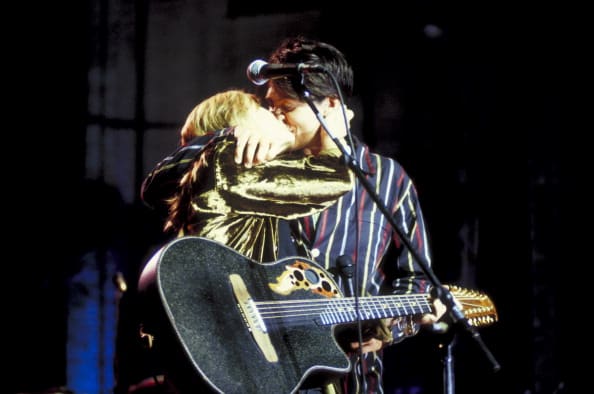
Melissa Etheridge and k.d. Lang perform during The Beat Goes On Concert Benefiting LIFEbeat at Beacon Theater in New York City.
Steve Eichner/WireImage/Getty
The show should be a riot if Etheridge is as candid and engaging as she is today talking about coming out, the Hollywood closet, love, losing and grieving Beckett, her passion for music and experience of fame, and why she loves to just rock out.
“There was another house in the Hollywood Hills above ours owned by the boss of my record company, Chris Blackwell, who rented it out,” she said, remembering the halcyon ’90s. “Once, Wesley Snipes was renting it, and Wesley was up there having a party, and we were down here having a party where it got to the point clothes were being removed. And his party got really excited looking down at our party. It was crazy. It was a great time, I just have to tell you. I had a lot of fun. That was in my twenties and thirties. I couldn’t do it now.”
Did Etheridge have more intimate relationships with lang, DeGeneres, or O’Donnell? “No, k.d., Ellen, and Rosie were very much like me. We all had that aggressive power, they were more like my brothers. I was attracted to more feminine—in relation to energy—women.”
Did she have relationships with other famous women? “Not that I can tell…” Etheridge said, before bursting into more laughter.
That sounds like a “Yes, but I’m not telling you who,” this reporter said.
“Yes, there you go,” said Etheridge, smiling.
“Ricky Martin was concerned because he was a sex symbol. I was like, ‘Dude, it’s obvious you’re gay.’ It’s been wonderful to see all these people finally come into themselves. ”
— Melissa Etheridge
After Etheridge came out, she was approached for advice by a lot of other then-closeted celebrities. “They would always come and confess. I had people come to me and say, ‘I see you being out,’ and they would apologize to me because they were not out. I would say, ‘Look, it’s very personal. It’s totally up to you, you don’t have to explain anything to me.’ There were a lot, and some have since come out.”
Which closeted-now-out celebrities asked for her guidance back then?
“Barry Manilow. Ellen, then she finally came out. Ricky Martin. Jodie Foster. Everyone would have their own reason for not coming out. ‘Television is not going to accept a gay character,’ blah blah blah. Barry was like, ‘All my fans are women. I will lose my fan base.’ I was so glad when he came out. I didn’t know Ricky well back then, but he was concerned because he was a sex symbol. I was like, ‘Dude, it’s obvious you’re gay.’ It’s been wonderful to see all these people finally come into themselves. The ones who come out do much better than the ones who don’t, or didn’t.”
When asked if she knew any celebrities who remained closeted, Etheridge paused, and said sadly, “Yeah, ones who decided to shut that part of themselves off, who got married, who really decided not to do it. It’s their choice, it’s always their choice, our choice. I would never out anyone. But to me, it just solidifies and tells me how good it is to come out, because one can see the difference between their lives and those of us who have come out and our happiness. Ultimately, your fame, success, and career are not going to keep you happy when you’re old.”
Coming out is always best, says Etheridge, “because being in your truth, whether it’s being gay or whatever, is your truth. It’s what you know. We have an inner spirit guiding us, always looking to joy and love. If we resist that we make ourselves sick. You will live a joyful life as long as you are connected with your spirit, your truth.”
“This is what I love to do”
Etheridge’s first memory is, when aged 3, hearing the Beatles sing “I Want to Hold Your Hand.” She always loved music: “I always found it to be a place of peace and release.” Growing up in Leavenworth, Kansas, she was close to her father, John, a teacher, and less so—as a child and teenager—her mother, Elizabeth, a computer programmer whose work was always credited to the men who worked around her. Etheridge has written that her older sister sexually and physically abused her when she was little.
“I wouldn’t say my childhood was terribly difficult, I would say it was unemotionally stifling,” Etheridge told The Daily Beast. “It was something I wanted to get out of. I had trouble with my sister, but everyone has their own situation growing up. Music was definitely the place where I got away from everything, where I could escape. It was the place that made me feel emotions, my hopes and dreams, and excitement.”
Etheridge recalled when first learning guitar aged 8, learning three particular chords. “When I first put those chords together, I said, ‘Wait a minute, this is a song in any kind of genre. I started making up things around that, and kept doing that. I have always felt a great desire to write since I was 11 years old.”
“It’s a very good thing I became successful because this is all I know how to do. I don’t want to do anything else. This is what I love to do.”
— Melissa Etheridge
She laughed again, a great, throaty, raucous laugh. “It’s a very good thing I became successful because this is all I know how to do. I don’t want to do anything else. This is what I love to do.”
As a child, she had lots of friends. “My parents, if you ever had to ask them, would have said I was a very good child. I didn’t cause any trouble. My older sister caused lots and lots of trouble, she took up all that sort of space. I wasn’t incredibly academic. If I was interested in a subject, I did well in it. Geometry was like, gah, I didn’t care.”
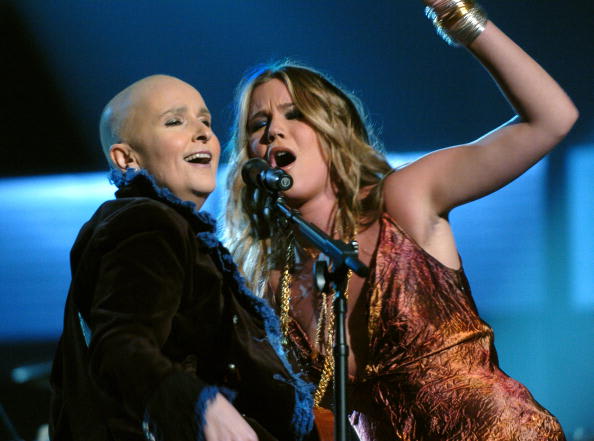
Melissa Etheridge and Joss Stone perform “Piece of My Heart,” a tribute to Janis Joplin.
L. Cohen/WireImage for The Recording Academy/Getty
Her mother “was definitely a product of before the women’s movement, before women’s rights. She was very smart, and went to college in the 1950s to find a husband. Well, she did, and they had kids immediately.” Her mother got a job as a secretary on an army base as a civilian, “which she loved at the same time as computers came into businesses. She was very good at programming the computers, but the guys got all the credit. She was paid half what they were paid. She got incredibly bitter about it, and she wasn’t a happy person anyway.”
When Etheridge turned 25, her mother retired, allowing her daughter to see a different side of her. “I became very close to her. She was a completely different woman to the woman I grew up with. I didn’t need the things I needed from her as a child. When you become an adult you see your parents as adults. You realize they’re just human, you let it go.”
Her father was a “wonderful, fun, light, kind human being” who had grown up very poor. His father had been injured in World War II and become an alcoholic, she says. Etheridge’s father managed to get a sports scholarship, and after college became a teacher and beloved basketball and athletics coach in Leavenworth, where a ballfield is named after him.
“My father and I had a really great adventure playing music in the Midwest in the 1970s.”
— Melissa Etheridge
Her father also loved Etheridge’s early love of music. “He supported me when I started playing in bands and bars at 12, 13 years old. He would drive me to every rehearsal and gig. We spent a lot of time together. He made that part of his life too. That added to trouble with my mother. She didn’t want me to do it. We did it anyway. My mother never wanted to come to any of my gigs. My father and I had a really great adventure playing music in the Midwest in the 1970s.”
Her father died when Etheridge was 35, fortunately able to see that she had achieved some success. Her mother eventually came to a few of her concerts. “She was a classical music kind of person, she never got into it. She was able to say, ‘I’m proud of you, good for you.’ She would always say, ‘Well things turned out OK I guess.’”
Etheridge has no relationship with her sister today. “It wasn’t devastating at all,” she told The Daily Beast of her sister’s abuse. “The confusing part was just how cruel she was to me. For a while, it kind of haunted me. I was looking for things, relationships, that were difficult. I wanted to get them to like me. For a while, it influenced me in getting into some bad relationships. Pretty soon you realize, ‘I have got to love myself.’ It was there for me to learn and I did. I definitely let what my sister did to me go a long time ago.”
And she never wanted a relationship as an adult with her? “As an adult, I wished for a sister I could have a relationship with, but I don’t want to have a relationship with her. We have nothing in common.”
“It was that moment. Coming out just felt right”
Etheridge came out publicly in 1993, when coming out was unusual and brave, conducted in the glare of the media, and there was considerably more ignorance and ill-informed gawping. She had come out to her parents many years before at around 18, 19. “My mother got a little weird about it until I was 25 and saw I was on my own and self-sustaining, and she said, ‘If you’re happy, fine.’”
Her father said, “Well, I don’t understand it, but as long as you’re happy, that’s all that matters.”
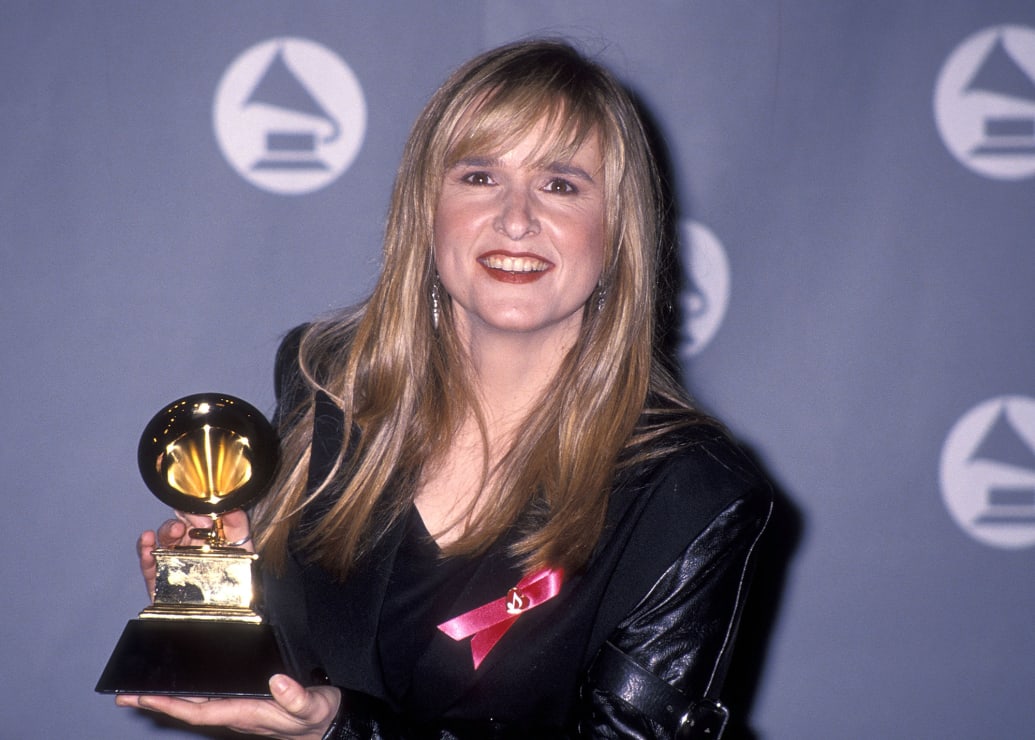
Melissa Etheridge attends the 35th Annual Grammy Awards on Feb. 24, 1993, at the Shrine Auditorium in Los Angeles, California.
Ron Galella Collection/Getty
“It was great to have that positive family base to then be able to come out publicly,” Etheridge says today. “By the time I was an active gay person, I was ready to get out of Kansas. You weren’t supposed to be gay back then, it was very much hidden,” Etheridge recalled. “There was no infrastructure for any kind of gayness in Leavenworth back then. But of course in high school, you find the ones that have the same energy as you do. They were my friends. When I went off to college—the Berklee College of Music in Boston—I met a huge gay community there.” (She received an Honorary Doctor of Music Degree from Berklee in 2006.)
“Personally, being gay was never an issue for me. I was just always, definitely attracted to women. I always knew I was gay. I didn’t know what that would look like in the world, but I knew what I was and that it made me happy. When I first signed to a record company, I said, ‘Look, I’m not going to pretend I’m not gay.’ They told me they didn’t want me to ‘flag wave.’ That’s what they said to me, whatever that means.” Another hearty Etheridge laugh. “Four years later, I would be flag-waving.”
“I had built up a considerable following playing in women’s bars, gay bars, and women’s music festivals. I had a fierce underground lesbian following. I thought, ‘I have to set this straight.’”
— Melissa Etheridge
Etheridge says she was stuck for a while in the entertainment world’s version of “don’t ask, don’t tell. In those days the press didn’t ask, and we didn’t tell. It happened all over the world. It was like, ‘OK, we’re gay, and you know we’re gay, but you’re not going to ask us and are not going to talk about it.’ But I did agree with my record label that I would never show up with a pretend boyfriend at events.”
She finally decided to come out of this demi-closet after an interview went awry. “It was for my Never Enough album, and the first time I had been on the cover of this particular magazine. Just like always, I used gender-neutral pronouns for my partner all the way through. But in the writing up of the interview, the journalist changed all the pronouns to ‘he,’ and ‘they’ to my ‘boyfriend.’ I thought, ‘Oh my God, people are going to think I have been lying.’ I had built up a considerable following playing in women’s bars, gay bars, and women’s music festivals. I had a fierce underground lesbian following. I thought, ‘I have to set this straight.’ It was one of the factors in me coming out.”
It was also a time, recalled Etheridge, when gay men and lesbians were organizing to help those gay men suffering the brunt of government ignorance and inaction over AIDS, “like, ‘We’re dying and they’re not doing anything.’” Etheridge recalled meeting community leaders like Urvashi Vaid, Elizabeth Birch, and Hilary Rosen, who “bless their hearts, took me in hand and little by little had me do fundraisers. They were so smart and out and clear about what needed to be done. It was in that spirit that I helped the Clinton/Gore (presidential) campaign.”
In 1993, at the Triangle Ball, the first ever gay inaugural ball held when Bill Clinton was elected to his first term, Etheridge came out, creating worldwide headlines. “I was surrounded by all these strong people. We had helped elect a president who spoke the words ‘gay’ and ‘lesbian.’ It was that moment. Coming out just felt right. I was going to do it anyway that year. I thought I would do it on The Arsenio Hall Show. It felt right. Slowly it went into the papers, and soon people were constantly talking about it.”
So, as a major lesbian icon causing worldwide headlines, was she also having lots of fun and sex? Was it groupie central?
“I wouldn’t call it groupie central,” Etheridge laughed. “Although I wouldn’t I say never did that! I would say until about 1991—when I finally wanted to be monogamous—before that, I had lots of fun. There were lots of beautiful, wonderful women I met, and I enjoyed myself very much.”
“We would always make sure to hold hands to say, ‘This is my partner. Here are two beautiful, successful women hanging out with everyone else.’ It was really important. ”
— Melissa Etheridge
In newspapers and magazines, Etheridge was one of the first queer celebrities to be photographed with their partners.
Etheridge welcomed the flashbulbs, and the change she hopes the images heralded. “It was really something that my partners and I knew, and each time we were invited somewhere, like some sort of premiere, we would always make sure to hold hands to say, ‘This is my partner. Here are two beautiful, successful women hanging out with everyone else.’ It was really important. If you had asked me back then, I would have said that in the future I would hope this was not a big deal and that my children would not know a world where it was crazy or scandalous to be seen with a woman.”
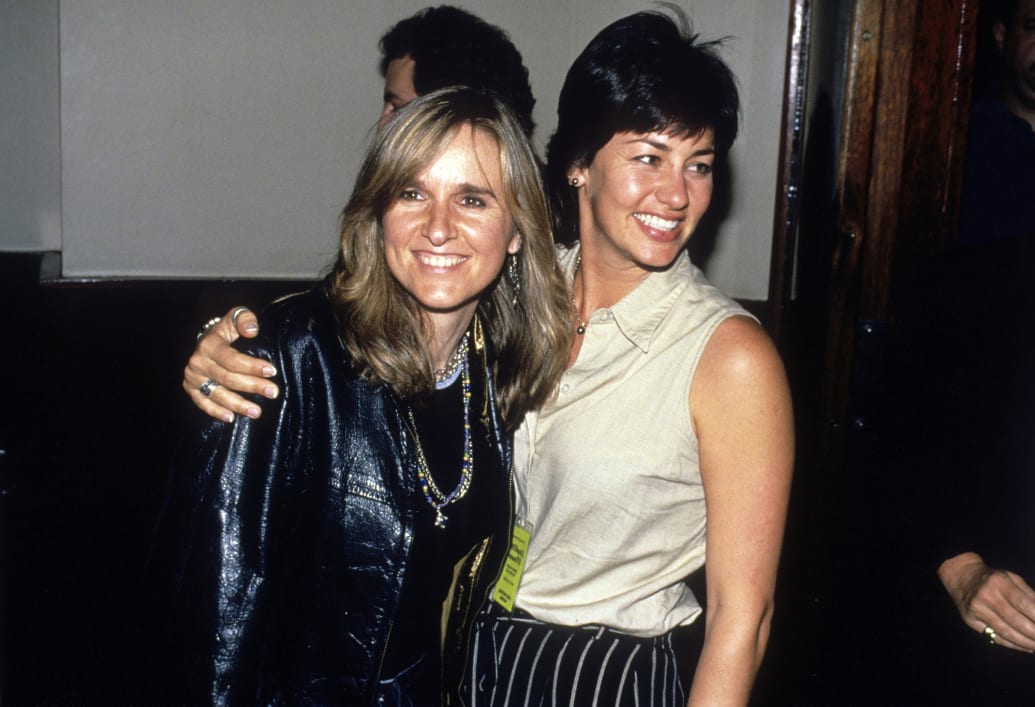
Melissa Etheridge and Julie Cypher at Lifebeat benefit at Beacon Theater, New York, June 24, 1994.
Steve Eichner/Getty
Today, Etheridge is hopeful that, despite the anti-trans and anti-LGBTQ bills in Republican-run state legislatures, and the collective ratcheting-up of anti-LGBTQ animus exhibited by politicians and the far right, that positive progress for LGBTQ equality will continue.
“I have lived long enough to see that our society, our social path, has taken great steps forward and also the backlash of fear by people who fear anything that is different,” Etheridge told The Daily Beast. “People truly believe their unhappiness is caused by someone else’s freedom. They believe that, and they’ve been told that by people who want to stay in power, that it is LGBTQ people’s fault that their children are in danger. It’s an old thing, repeated again, to pull us back from progress—sexual, racial, whatever. This whole golden idea of democracy and America and rights for all is constantly challenged.
“One good thing is that it means we, as an LGBT community and as part of America and the world—have integrated. We are comfortable, we are happy, we are successful. We’re moving on with our lives as part of that bigger fabric—and it makes some people uncomfortable. There will always be divide and conquer politics, but we don’t lose our ground if we carry on pushing forward. And it isn’t progress if your attitude is ‘Gays are OK, but we draw the line at this trans thing.’ You’ve got to understand freedom of expression. That’s what America is about. Once we stop being so afraid of that, the majority of people will see it doesn’t matter and we can move on.”
To those who are anti-trans equality, Etheridge said, “Everyone wants to shut the door behind them. Don’t do this. Maybe you don’t understand it, but do unto others as you would want to be done to you. Remember those people who didn’t or don’t understand what ‘gay’ is. Know that another person’s difference is not hurting you. And you don’t have to understand it, or do it, or believe it, or whatever. Just let it be, because it’s part of someone else’s experience and your experience is not theirs.”
“When you define yourself by what you are against, ultimately people will see you are not for anything.”
— Melissa Etheridge
Etheridge believes that “showing love,” being the best person one can be, and cherishing oneself and others, are the most effective ways of resisting naysayers of all kinds.
“Coming out is the best thing a person can do, in the family or workplace,” Etheridge told The Daily Beast. “When you are that example, it changes hearts and minds. It gets overwhelming and depressing to think that we have to fight. I know and appreciate those activists and campaigners on the frontlines fighting to change laws and so much else. But as a general population, let’s show we are a loving people filled with hope and desire, loving our children and neighbors, and contributing to the world. Ultimately, you can’t fight that. It speaks for itself.”
To those politicians, like governors Ron DeSantis in Florida and Greg Abbott in Texas, who seem intent on passing as many anti-trans and anti-LGBTQ bills as possible, Etheridge says, “You are putting yourself in a box. I’ve seen people putting themselves in this box before. When you define yourself by what you are against, ultimately people will see you are not for anything. And there is a generation coming up behind us that thinks we are all very foolish. I have children. I meet their friends. Their generation are going to look back on this just like how we looked back on the horrible bigotry of the 1950s and 1960s. To all of those politicians, I would say that your legacy is not going to be a revered one.”
“He taught me that I cannot save anyone else”
Etheridge was with Cypher for 10 years, during which time Cypher gave birth to two children, Bailey Jean and Beckett (with sperm donated by musician David Crosby), then with Tammy Lynn Michaels between 2003 and 2010 (they had twins Johnnie Rose and Miller Steven in 2006). She has been married to Wallem, an actor and writer who co-created the TV series Nurse Jackie, since 2014.
‘I am with the right person now because I have found myself,” Etheridge told The Daily Beast. “What people may have witnessed over the years was a woman’s journey to understanding what love is. Love is not someone else fixing me. Love is not someone fixing the perceived fears and holes in me. I thought I needed someone to tell me I’m OK, or someone who was beautiful to make me feel beautiful. These things took me into relationships. My journey has been to take me to a place of confidence, to say, ‘OK, no, I just need to love myself.’
“Before Linda and I became lovers I was like, ‘That’s it, I’m done. I don’t need a relationship. I have my children, work, me. I’m very happy.’ The minute I got to that was when I looked up and saw Linda. We were both naturally attracted to each other, both successful, both enjoy happiness. That last one is the number one thing to do every day. When you have that, that’s a relationship that can work.”
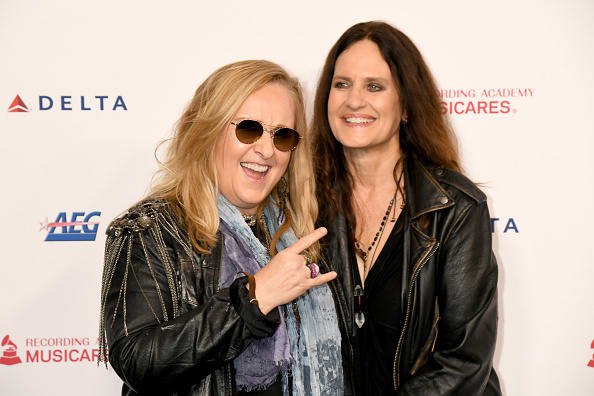
Melissa Etheridge and Linda Wallem attend MusiCares Person of the Year honoring Aerosmith at West Hall at Los Angeles Convention Center on Jan. 24, 2020, in Los Angeles, California.
Jeff Kravitz/FilmMagic/Getty
Having children was “not something I ever planned on,” said Etheridge. “I was a gay rock star and when you were gay in the 1960s and ’70s, that meant not having children. It wasn’t even an option. Then in the early ’90s, it was like ‘Oh, we can do this.’ Both of my partners who I had children with were really into it, and I was like, ‘Sure I can.’ And then, when I had my children, oh my God, it was like, ‘This is amazing,’ the hardest thing I ever did but incredibly rewarding. Even when my son left this earth, and the choices he made, I would still not change a thing. To know that kind of love, the things he taught me about life…”
Beckett’s death, as a result of opioid addiction in May 2020, has inevitably had a huge effect on Etheridge and her family.
“He taught me that I cannot save anyone else, and I am not supposed to save anyone else,” Etheridge said. “The best thing I could ever do for him was stand in my own truth and my love of myself, take care of myself, and try to show him that. He never caught on to that part, but then of course the drugs had him by then.”
“He helps me now by knowing that I have to turn those thoughts into joy, that I can’t let those thoughts bring me down.”
— Melissa Etheridge
How has her experience of grief been so far?
“It’s endless. I don’t imagine I will ever stop thinking about him,” Etheridge told The Daily Beast. “I find myself constantly thinking about him. He helps me now by knowing that I have to turn those thoughts into joy, that I can’t let those thoughts bring me down. That doesn’t help. He doesn’t want that, now he’s in a pain-free place. I truly have a deep belief we are in a physical reality and the non-physical reality is right there with us and we are doing this together. I really feel him when thinking about him with love. That’s when he is closest with me, and he teaches me to be more loving in my thoughts also.”
Etheridge said Beckett’s addiction lasted for four years, beginning when he was 17. “It was four years of a downward spiral, and I kept thinking, ‘We’ll keep putting him into programs,’ ‘You’ve got to learn this, get this.’ Life was too hard for him, and when you have an easy out with drugs—I can understand it. I always had a joy of life, but he never really did. When he had a snowboarding accident, it shattered his life. He couldn’t do what he loved anymore. He didn’t have any self-confidence.
“Then it was four years of watching him slowly go down. I put him in programs. I cut him off. You do everything you can think of. You think, ‘There’s something I can do, I can save him. I can show him. I can punish him into this. I can do something.’ Then, finally, towards the end, I realized, ‘I can’t do anything else, I know I may get the call any day that he’s dead. It’s up to him. It’s his life. He has to figure something out. He made these choices.’ By the time he died, I wasn’t surprised. I was incredibly sad. I hadn’t heard from him in four days. They sent police officers to check on him, and then I was told, ‘He’s gone.’
“We celebrate how funny and joyful he was. He’s still with us, and we help each other not bring any kind of guilt and shame into our home.”
— Melissa Etheridge
“You say to yourself, ‘If I would have done that, I should have done that.’ The guilt and shame will eat you up. It was very, very stressful. It took a little while for our whole family to recover. We still are. We bring his memory in, we celebrate him. We celebrate how funny and joyful he was. He’s still with us, and we help each other not bring any kind of guilt and shame into our home.”
Etheridge has set up a foundation aimed at helping fund research into plant-based medicines, something spurred not just by Beckett’s death but by her own experience of surviving breast cancer. A “heroic dose of cannabis” at the time of her own illness changed her attitude towards her own “joy and health.” It was also such a huge trip, it also made her think she might die, and if so “dying might not be so bad. Death is just going out of this form. I don’t end. My soul, all of our souls, are forever. I don’t let death trip me up now. I love getting older. I don’t worry about aging. I don’t care. I love being in my 60s.”

Melissa Etheridge performs on stage at San Diego Pride Festival 2019 on July 14, 2019, in San Diego, California.
Daniel Knighton/Getty
Cannabis remains a big part of her life. “I take vitamin B pills, but that’s my only medicine,” Etheridge said. “It helps me sleep, it helps me create. Cannabis doesn’t affect me as much as it does other people because I am a regular participant in it. I think cannabis is good for a lot of things.”
Having a show in New York has been “a dream for a long time.” She yearned for fame from the beginning of her career. “When I got my first record deal, I wanted more. Then I played in clubs, it was more, bigger theaters—more. It was always ‘more’ until you get to the top of the highest mountain and think, ‘Oh is that all this is?’ Then I went on a journey on to find myself. It was like ‘That dream has come true so now what do I do to bring me joy.’ That’s the journey I have been on ever since.”
Was it difficult having a lot of fame, and then becoming less famous?
“It was difficult for a few years until I got cancer,” Etheridge told The Daily Beast. “You get to the top, and think, ‘Oh, I think I want to stay here.’ Then it starts to wane. You think, ‘Oh, wait a minute. I need to stop trying to be a hit to 18-year-olds. I’m getting older. I need to be true to myself and make music. I want to be legendary, so I have to live my life and create the music that will entertain and inspire people.’
“Legacy is very important to me. I look to my inspirations, like Bruce Springsteen. He has kept on becoming what he wanted to be.”
“That’s why, after cancer, I resolved that I was never going to think of ‘Is there going to be a hit?’ I am going to create music I want to play live. I want people going to my concerts and performances to say, ‘Oh, this is on my bucket list. To see Melissa Etheridge in concert is an experience everyone should want to experience.’ Legacy is very important to me. I look to my inspirations, like Bruce Springsteen. He has kept on becoming what he wanted to be. I have made 18 albums or something. That amount of music: I want to hold on to that catalog, revere it, love it, and create what I can after it.”
Etheridge has worked with Springsteen, and there are many other “wonderful artists” she would love to work with. “I always wanted to sing with Steven Tyler. I always wanted to rock out with him. Adele! Come on! People who love to sing and entertain. There are so many younger artists of color who I love, like Mickey Guyton and H.E.R. Basically, anyone who loves music I would love to work with.”
She really, really loves to rock out? “Indeed, it’s a wonderful experience and I love it,” Etheridge said, laughing. Music is her all-consuming, fiercely loved occupation and passion, but when relaxing she will pick up her guitar “every now and again to keep my calluses going.” Otherwise “I let my family and my love of football take my time.” (Naturally for a rock star raised in Leavenworth, her team is the Kansas City Chiefs.)
In farewell, this reporter asked Etheridge if there was anything else she wanted to say.
“For heaven’s sakes, I think we talked about everything,” Etheridge said, with a final roar of laughter.